

Jev vs. LLM: Typed Decisions or Open-Ended Language?
A business gets dozens of customer messages. Some ask for a quote, some report a problem, and others just want the opening hours. Do you need AI to write an essay about each one? Probably not.


A business gets dozens of customer messages. Some ask for a quote, some report a problem, and others just want the opening hours. Do you need AI to write an essay about each one? Probably not. Before choosing a tool, ask what the process needs to produce: a decision among known options, an open-ended explanation, or a responsible person's judgment.
The short answer
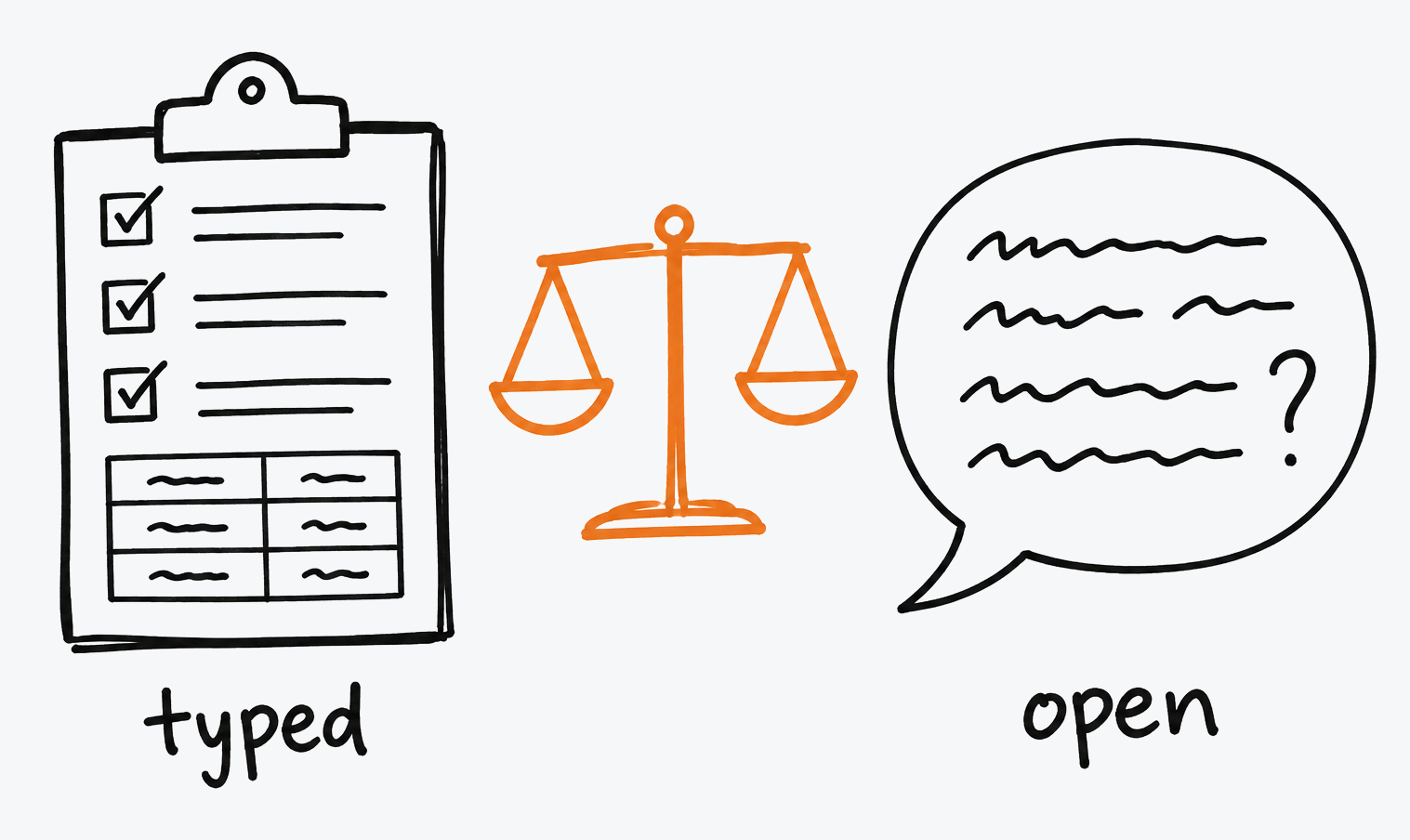
A model designed for predefined decisions, such as TypeSafe AI's Jev, can classify, score, or estimate the probability of a yes/no answer. A large language model (LLM) can draft, summarize, and handle open-ended questions. Neither should independently decide what happens to money, sensitive data, or people. Business rules, code, and an accountable person set the boundaries.
The basics of the other side of the comparison: what an LLM is and what it is for.
Jev is in early access. It is not a required purchase or a proven fit for every business. The useful question is which part of the work needs repeatable judgment and which part needs language.
An example: the support inbox
Imagine a service business receiving customer tickets. This example is fictional; it makes no claim about Jonathan's operations or results. The team first defines its routes: sales, support, billing, and an option for cases that do not fit. It then tests three questions for each request:
- Choice: Which of those routes fits the ticket? It returns a defined option and a probability distribution.
- Score: Where does the message fall on an urgency scale defined by the team?
- Noul: Is the customer asking for a refund? It returns a probability of yes, not an instruction to pay.
With Jev, these questions can be sent together against the same input state. Code then applies policy: suggest a route for low-risk cases, request review when uncertain, and never authorize a refund just because a score looks high. If the customer needs a clear written answer, an LLM can draft one for a person to review. We do not hand the cash drawer keys to a classifier because it sounds confident.
Can an LLM return structured data too? Yes. This is not a universal law of 'text versus numbers.' Jev is built for typed questions with predefined options and probabilities; many LLMs also support schemas or structured output. Test both on the same task and validate either output.
A simple way to choose
- Fixed rule: If the data already determines the answer unambiguously, use ordinary code. 'If the due date is today, mark it due' does not need AI.
- Repeatable judgment: If a person can recognize a pattern but rules for every case are brittle, test typed classification or scoring.
- Open-ended language: If the work calls for explanation, drafting, summarizing, or conversation, test an LLM with review proportionate to the risk.
- Consequential decision: If rights, money, safety, or privacy are at stake, keep a human accountable, define policy, and set a stop path.
How to test without the hype
Use representative examples with permission and protected data. Define the right answer or review standard in advance, then compare a simple rule, an LLM with structured output, and Jev if you have access. Count different kinds of error separately: sending a routine question to sales is not the same as missing an urgent complaint. Measure response time, total cost, consistency, and how much review work each approach creates. Check whether predicted probabilities match real outcomes before treating them as reliable risk levels. Set thresholds and a route to abstain or escalate; 87% is not a guarantee.
If you want to run an LLM without your data leaving the building: AI that codes on your own computer: local LLMs.
TypeSafe reports striking speed and cost figures in its own evaluations, but also notes favorable conditions in one demonstration and possible bias in its workflow tests. Those are vendor results, not a promise to your business. It also says Jev cannot produce an answer outside the declared type: that prevents shape errors, not bad decisions. A perfectly formatted answer can still be wrong.
Your next step
Pick one low-risk, repeated judgment. Write down the permitted answers, who reviews unclear cases, which error would stop the pilot, and how you will measure today's process. Then test small. The best tool is not the one that looks most futuristic on a slide. It is the one that helps without hiding the cost of mistakes.
Sources and editorial note
Inspired by Brij Kishore Pandey's (@codewithbrij) September 28, 2026 reel: https://www.instagram.com/reel/Dd23pmFOxme/. Product description and caveats: TypeSafe AI, 'Introducing System One Models and Jev': https://typesafe.ai/blog/introducing-system-one-models-and-jev; primitives documentation: https://docs.typesafe.ai/primitives. Comparative performance claims come from the vendor and need independent testing for each workflow.
Was this article helpful?