
What is an LLM and what is it for?
If you've used ChatGPT, Claude or Gemini, you've already met an LLM; nobody just introduced you properly. LLM stands for Large Language Model. It's the software “brain” behind almost all the AI you hear about today.


If you've used ChatGPT, Claude or Gemini, you've already met an LLM; nobody just introduced you properly. LLM stands for Large Language Model. It's the software “brain” behind almost all the AI you hear about today.
The short version: an LLM is a program that read an absurd amount of text and learned, statistically, what comes next in a sentence. Sounds simple. What's surprising is how much that single trick can do.
What does “large language model” actually mean?
Let's take the name apart:
- Large: it has billions of internal “settings” (parameters), tuned by reading much of the public internet, books and code. Training one costs millions of dollars in computing power.
- Language: its raw material is language; it reads and writes. Newer models also handle images and audio, but language is still the core.
- Model: it's not a database or an encyclopedia; it's a mathematical representation of patterns in language and in the world described by those texts.
There are also SLMs (Small Language Models): the compact edition. They fit on a laptop or a phone, they're cheaper and more private, just less capable. Hence the “LLM / SLM” in the drawing.
How does it work? Little pieces and predictions
An LLM doesn't read whole words: it chops text into pieces called tokens. A token can be a word, half a word or a punctuation mark. “The cat drinks…” becomes a row of tiles, and the model calculates the most likely next tile: “milk”.
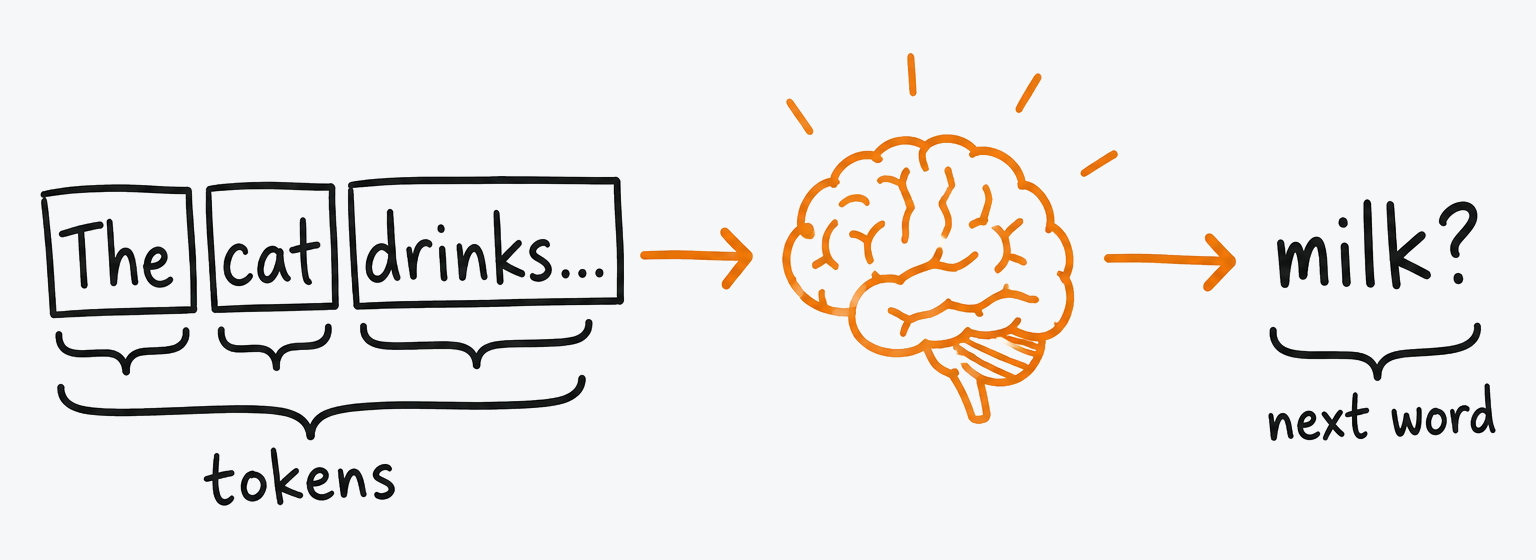
And that's all it does. Every answer ChatGPT gives you is that same move (predict the next token) repeated hundreds of times a second. It's your phone's autocomplete, but after reading half the library.
So don't be surprised when it gets something wrong with total confidence: it's not “thinking” like you; it's completing patterns. That's called hallucinating, and it's the golden reason to double-check numbers, dates and quotes before using what it writes.
A brain with senses… and hands
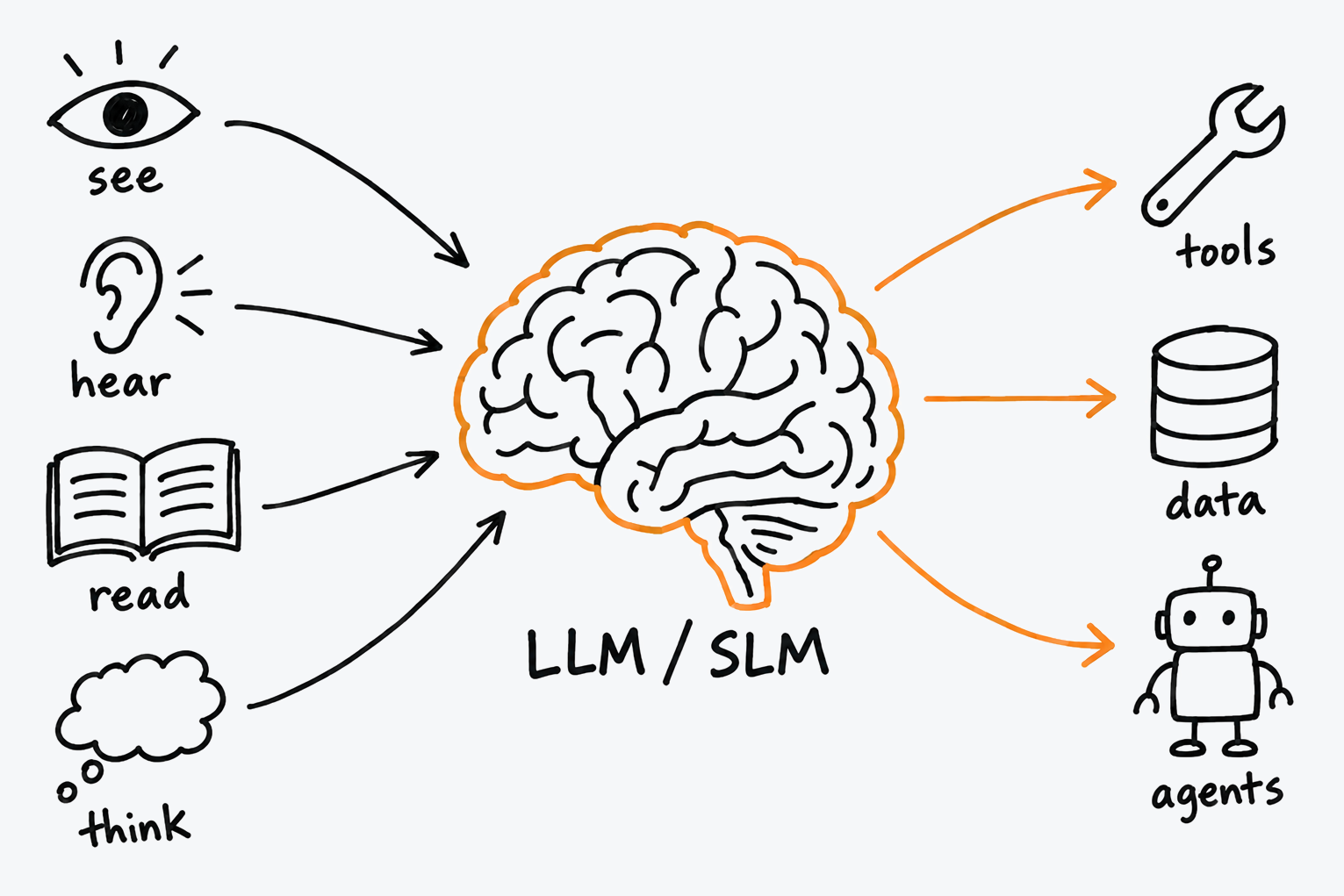
The drawing sums up today's models well. On one side, they no longer just read: they can see images, hear audio and reason, generating intermediate steps before answering, like someone thinking out loud.
On the other side, they no longer just write: connected to the right pieces, they can use tools (search the web, send an email), query data (your catalog, your reports) and coordinate agents that carry out full tasks. I covered that in detail in the post about AI agents.
What is it good for in a business like yours?
- Drafting and summarizing: emails, proposals, meeting notes, job descriptions.
- Answering with your information: an assistant that replies to customer questions using your documents, not its imagination.
- Translating and adapting: the same content in two languages, in your brand's tone.
- Reading for you: contracts, reports and quotes summarized into paragraphs that actually make sense.
- Coding and automating: from an Excel formula to full workflows between your systems.
What an LLM doesn't do well
- Inventing with confidence: if it doesn't know, it completes the pattern anyway. Verify what matters.
- Knowing your business: by default it knows nothing about your company; you have to give it context or connect it to your data.
- Keeping secrets: don't paste sensitive client information into tools you don't control.
- Replacing your judgment: it proposes, drafts and accelerates; the decision and the responsibility stay with you.
The best mental model: a brilliant intern who read the whole library, works 24/7 and charges pennies… but occasionally states false things with a smile. Give it clear context, put it on concrete tasks and review its work. With those three rules, it's one of the most useful tools an office has ever had.
Was this article helpful?