
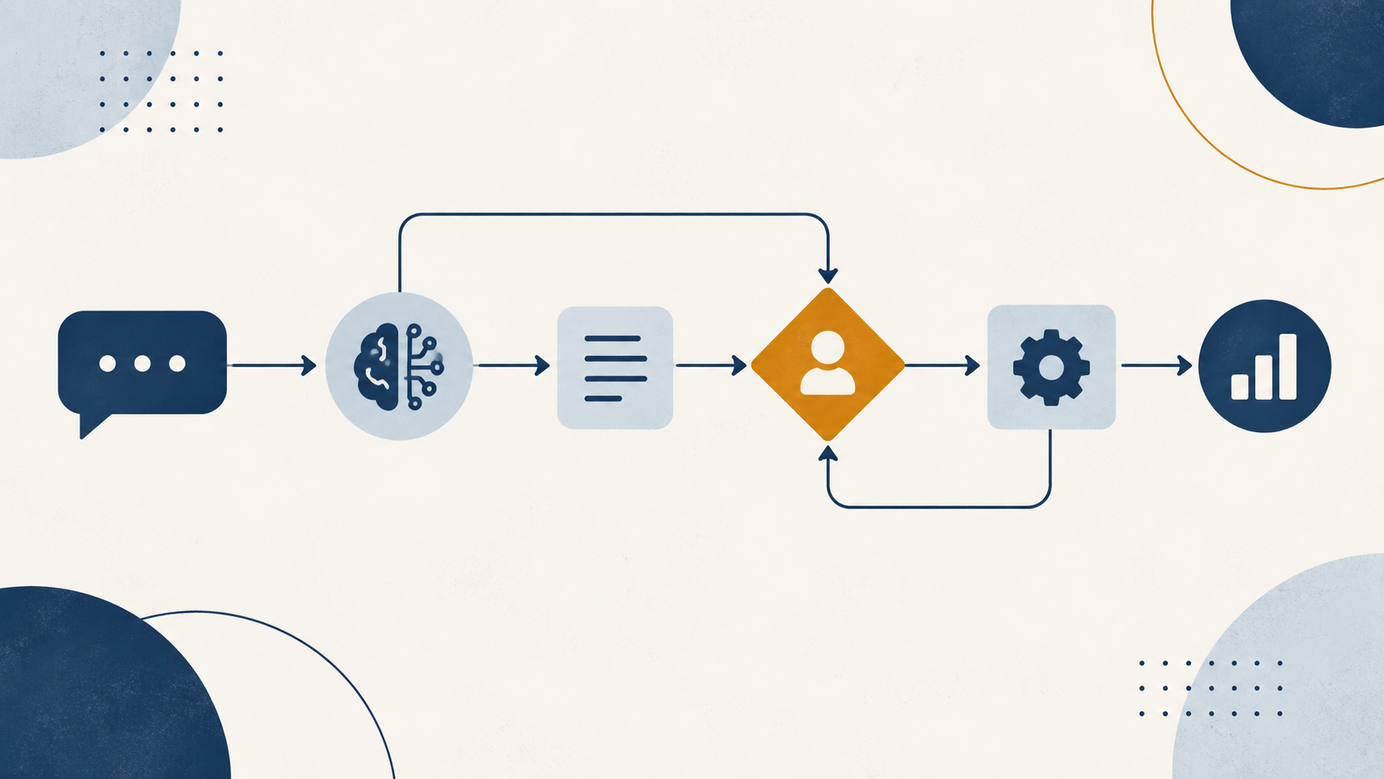
From AI chat to AI work: what the September 2026 agent announcements mean for your business
Ask an AI chatbot to summarize a customer complaint. It gives a useful answer. You still have to find the order, decide whether to offer a refund, update the customer record, and send the reply.


Read together, the September announcements mark the moment AI agents for business stopped being a roadmap slide and became shipping product.
Ask an AI chatbot to summarize a customer complaint. It gives a useful answer. You still have to find the order, decide whether to offer a refund, update the customer record, and send the reply. Now imagine software that can look up the order and prepare those next steps. The difference is not a smarter paragraph. It is the ability to work across a process, and possibly take action.
That is the thread connecting several AI announcements this September. On September 10, OpenAI introduced an Agents API for developers, in public beta. On September 25, Microsoft described a new Copilot experience and a persistent agent called Autopilot, expanding to private preview at the end of the month. Microsoft also detailed Work IQ, which connects business application context to Copilot and agents, with a preview scheduled to begin September 30. UiPath's September 23 platform update likewise emphasized governed automation and reusable routines. These are different products, serving different customers, and some are previews. None is a reason to hand over your operations tomorrow. Together they raise a useful question: which piece of work would your business trust software to prepare, and which decisions must remain yours?
A chatbot answers; an agent can work through steps
The words are slippery. A chatbot usually responds to a prompt. A copilot may help inside an application. An agent may pursue a goal over several steps, use tools and return a result. Product labels vary, so ask what the software can actually read, change, send or spend. That is more useful than arguing over the name.
The guide for choosing between them: do you need a chatbot, a copilot or an AI agent.
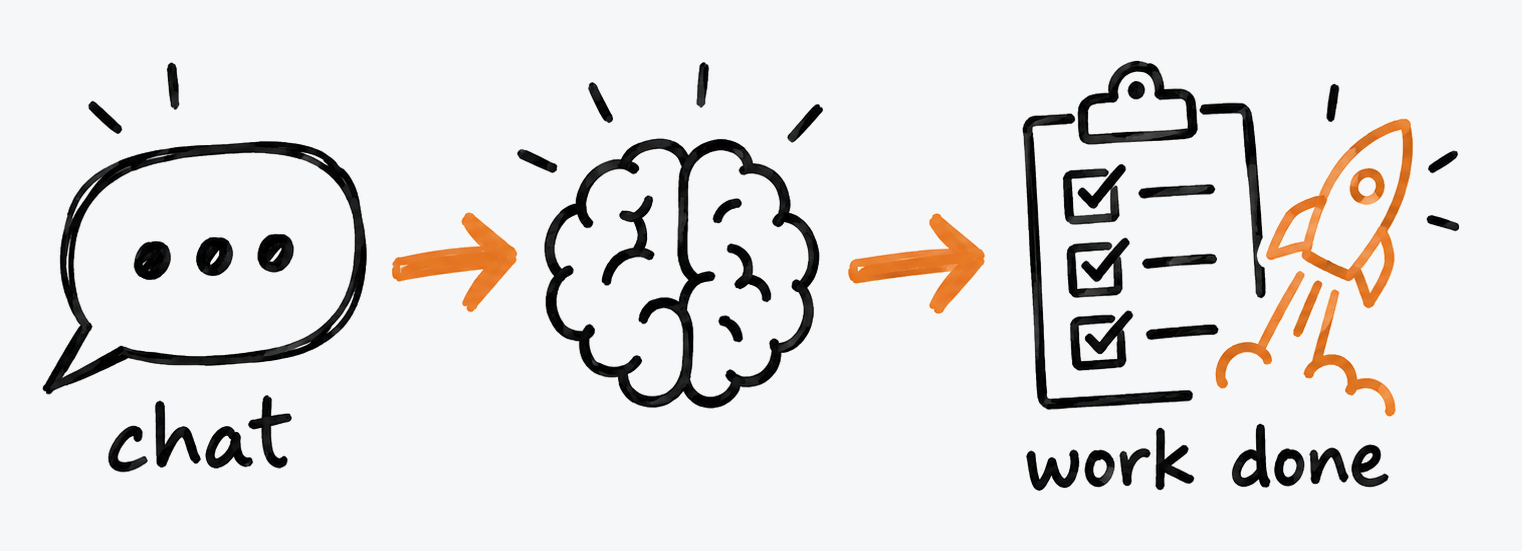
Consider a sales inquiry. A chat tool can draft a reply after someone pastes in the email. A connected agent might classify the inquiry, check stock, prepare a quote, and put a proposed reply in the right place. If you also allow it to send the quote and alter the price, the authority has changed. Each step has a different consequence. Drafting is easy to inspect. A wrong price sent to a customer is harder to undo.
OpenAI says its Agents API provides a managed framework for building longer-running agents, including sessions and subagents. It is a developer building block, not a finished operating system for your company. The API is in public beta. OpenAI says there is no extra API fee beyond tokens and tools, but your business would still pay for design, integration, testing, ongoing operation and human review. A lower technical barrier does not choose the right process for you.
The real product is the workflow
Many small firms are tempted to start with a demo: a tool reads a document, finds a customer, and makes a chart. A demo proves a capability in one controlled moment. It does not prove that a process works on Monday when a record is missing, a customer changes an order, or two people disagree on who owns the next step.
Before the demo, it helps to send these questions: what a founder should ask an AI agent vendor before buying.
Write the work down before choosing a model. What triggers it? What information is reliable? Where does that information live? What should happen when it is incomplete? What would count as a good result? Who checks an exception? If nobody can answer those questions, automation will not remove the ambiguity. It may hide it until the error reaches a customer.
Microsoft's Work IQ announcement illustrates why context matters. The company says its approach can bring information and workflows from Dynamics 365 and Power Platform into Copilot, and can require approvals before governed actions update records. That is an announcement about its ecosystem; its preview starts September 30 and continues rolling out in October. The broader lesson does not depend on using Microsoft: an agent needs the right records, a clear business rule and permission to act. Giving it access to every file is not the same as giving it good context.
Decide the authority before the tool is connected
A practical way to begin is to sort actions into three levels. First, the agent may read approved data and prepare a draft. Second, it may make reversible changes, such as adding a task or categorizing a ticket, with a human review queue. Third, it may send messages, change financial terms, delete records or make a purchase. Those high-consequence actions need explicit approval and a clear audit trail. The boundaries should follow the cost of a mistake, not how impressive the demo looks.
Microsoft describes Autopilot as having an identity, memory, a workspace, permissions and audit controls. It is expanding to private preview at the end of September, so do not assume it is available to your company today. UiPath's September update similarly stresses policy, traceability and enterprise data context. These are vendor descriptions, not independent proof that every deployment will be safe. Ask each provider to show exactly what an administrator can limit, what is logged, and how an action is stopped or reversed.
Data access deserves the same care. If an agent reads customer files, where does that information travel? How long are logs retained? Who can view them? Anthropic's September announcement of Enterprise Frontier Safeguards focuses on optional enterprise controls over monitoring and storage. That may matter to some organizations, but an owner should read the applicable configuration and contract rather than translate a security headline into a blanket privacy promise.
Run a small pilot with a real scorecard
Choose one frequent task that has a clear beginning and end, a known human owner and mostly reversible steps. For example, have software prepare a weekly service-ticket digest with proposed next actions. Keep sending customer messages out of scope. Before the pilot, measure how long the team spends gathering facts and correcting errors. Record a normal week, not your best day.
During the test, track four things: time spent from request to useful result; error and rework rate; the share of cases needing an exception; and full cost, including software usage and human review. You can add customer response quality if the task touches customers. A pilot that saves ten minutes of drafting but creates fifteen minutes of checking is not a win. Neither is a fast answer built from outdated data.
The full pilot evaluation, step by step: how to tell whether your AI pilot actually helped.
Write down a stop rule. If the agent changes a record it was only meant to read, if it cites the wrong customer, or if nobody can explain an unexpected action, pause and investigate. Keep a person responsible for the outcome even if the software completes most steps. If the pilot performs well, expand one permission or one workflow at a time. That makes it easier to tell what actually improved.
Do not confuse the release calendar with your plan
The September announcements contain public beta, private preview and later rollout dates. They are signs of product direction, not a procurement deadline. Microsoft also says long-running agentic work uses usage-based billing in its new Copilot pricing approach; a license price alone may not describe your final bill. Ask the vendor for your specific availability, permissions, usage estimate and exit path before putting a figure in a budget.
The business opportunity is real enough to test, but the decision is ordinary management. Define a job. Name the owner. Limit the data and actions. Measure the whole process. Review the result with the people who do the work. If the pilot earns trust, give the software more responsibility deliberately. An AI agent should make your company easier to run, not harder to understand.
Sources and fact-check notes
• OpenAI, "Introducing the Agents API," September 10, 2026: https://openai.com/index/introducing-the-agents-api/ (vendor announcement; public beta and pricing statement).
• Microsoft, "Introducing the new Copilot with Home, Code and Autopilot," September 25, 2026: https://blogs.microsoft.com/blog/2026/09/25/introducing-the-new-copilot-with-home-code-and-autopilot/ (vendor announcement; release stages and billing model).
• Microsoft, "Work IQ: Business and workplace intelligence in the flow of work," September 25, 2026: https://www.microsoft.com/en-us/dynamics-365/blog/it-professional/2026/09/25/work-iq-business-and-workplace-intelligence-in-the-flow-of-work/ (vendor announcement; preview timeline).
• UiPath, "UiPath Enhances and Strengthens UiPath Platform," September 23, 2026: https://www.uipath.com/newsroom/uipath-platform-updates-fusion (vendor announcement; controls and workflow claims).
• Anthropic, "Developing Enterprise Frontier Safeguards with our customers," September 1, 2026: https://www.anthropic.com/news/enterprise-frontier-safeguards (vendor announcement; optional security controls).
Was this article helpful?