

How to measure and improve your productivity (without lying to yourself)
If you answered 40 emails today, sat through five meetings and closed your laptop at 8 PM, were you productive? Most people would say yes, because the day was exhausting. But exhaustion and productivity are not the same thing.


If you answered 40 emails today, sat through five meetings and closed your laptop at 8 PM, were you productive? Most people would say yes, because the day was exhausting. But exhaustion and productivity are not the same thing.
It is worth putting some order into this: what productivity is, how to measure it without bureaucracy, and how to improve it without working longer hours.
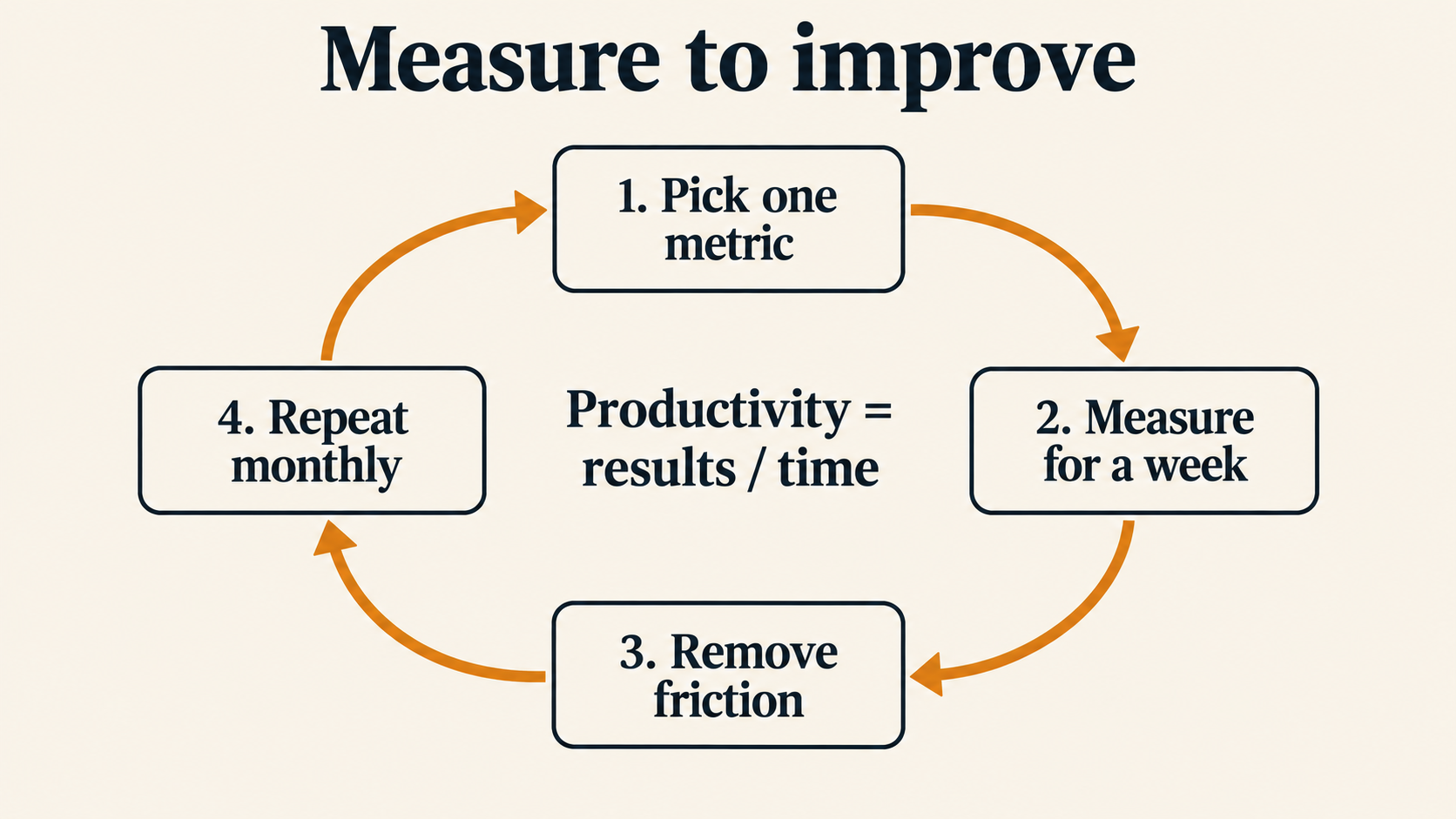
First: choose what to measure
You can't improve what you don't see. But measuring the wrong thing is worse than not measuring at all, because it pushes you to optimize for an illusion. Three signals that actually matter:
- Results delivered per week. Not tasks checked off: finished things that someone uses. The sent proposal, the resolved case, the published improvement, the closed decision. If your week contains zero deliverables, it doesn't matter how full the task list was.
- Hours of deep work. The time you spent on what genuinely moves your role, without notifications or half-attention meetings. Most professionals discover they have between 30 and 90 real minutes a day. The number is usually uncomfortable to learn. It is also where improvement starts.
- What got in the way. Interruptions, unclear meetings, waiting on other people, rework caused by missing specifications. Recording the obstacle matters as much as recording the result: it shows the system you work inside, not just your own behavior.
What NOT to measure: hours at the desk, number of emails answered, meetings attended. All of those measure presence. Nobody gets promoted for presence.
The other side of that coin is being a good operator: what operations are and why being a good operator accelerates your career.
A 15-minute weekly review
You don't need an app, a template, or a complicated system. A note on your phone and one weekly appointment is enough. Same day, same time. Friday at the end of the day works well:
I wrote about what that kind of week feels like before putting numbers on it: a productive week doesn't feel busy.
- What did I deliver this week? List finished results. Be strict: "worked on the report" doesn't count; "sent the report" does.
- What was my best deep-work block? When it happened, what protected it, what it produced.
- What consumed the most time? One or two items. Briefly.
- What will I change next week? ONE adjustment. Not five.
Fifteen minutes. If it takes longer, the review itself has become the work.
The three most common leaks (and their fixes)
After a few weeks of reviewing, the same three leaks appear in almost everyone's notes:
- Unclear priorities. The week starts and nobody, including you, knows what matters most. Fix: before Monday begins, write down the one thing that, if finished, would make the week a win. One thing. Then defend it like a meeting with your most important stakeholder, because functionally it is.
- Interruptions. Messages, "quick questions", notifications. Fix: batch them. Check messages at set times, and when you work on something important, close the door, physical or digital. You don't need to answer in 30 seconds; you need to answer well.
- Rework. Doing things twice because nobody defined what "done" looked like. Fix: before starting anything that costs more than an hour, ask or define what the finished deliverable looks like. Thirty seconds of clarity saves hours.
The rule: one change per week
This is where most productivity attempts fail: enthusiasm. The person completes a first review, finds six problems, and decides to fix them all on Monday. By Wednesday the system has collapsed, and by Friday the week is back to "busy".
Change one thing per week. Only one. If this week's leak is interruptions, the change is "messages at 10, 1, and 4" and nothing else. The following week you check whether it worked and pick the next change. Twelve weeks of that produces twelve sustained improvements. Twelve weeks of trying to change everything produces none.
Energy is also productivity
One last factor the stopwatch misses: not all hours are worth the same. You have two or three hours a day when your thinking is noticeably sharper. The weekly review will show you which ones they are.
Once you find them, treat them accordingly: the day's most important work goes there. Shallow work (messages, forms, coordination) goes everywhere else. This sounds obvious. Almost nobody does it. It is one of the cheapest advantages available.
The point isn't the metric
A final caution: if this turns into an obsession with numbers, you have simply built another way to feel busy. Measurement is a flashlight, not a report card. Use it to see where your time goes and make better decisions, not to grade yourself.
The goal of measuring your productivity is not to work more hours. It is for the hours you already work to leave something visible. And for the next 8 PM to come with a better answer than "busy".
Was this article helpful?