

What are operations and why being a good operator accelerates your career
There's a person in your company whose absence is felt immediately. When they're on vacation, deliveries slip, questions go unanswered, and small problems turn into meetings. When they return, order quietly comes back, and nobody can quite explain what they did.


There's a person in your company whose absence is felt immediately. When they're on vacation, deliveries slip, questions go unanswered, and small problems turn into meetings. When they return, order quietly comes back, and nobody can quite explain what they did.
That person is a good operator. This article covers what that means, why it is one of the most undervalued skills in the job market, and how to start building it this week.
What "operations" is (in plain words)
If strategy decides where the company is going, operations is how the company actually runs every day to get there. It is everything that has to work, work well, and work again tomorrow: processes, people, tools, money, information.
I wrote the guide for that other half here: what a strategy is, how to build one and how to execute it.
Operations is not a department. It is a layer of reality that exists in every company:
- In a restaurant: that ingredients arrive, the kitchen doesn't stall, and every table gets what it ordered.
- In an agency: that projects move forward, clients get answers, and nobody discovers a due date on the day it was due.
- In your own job: that your work arrives on time, complete, without surprises, and without anyone having to chase you.
Strategy gets the applause in presentations. Operations pays the bills in silence. And when it fails, it is all anyone talks about.
The traits of a good operator
You can spot them within a month of working with someone. A good operator:
- Is reliable: if they say Thursday, it is Thursday. And if it is going to slip, they say so on Tuesday, not Thursday afternoon.
- Follows up: things don't fall through the cracks. They have a way, simple or sophisticated, of knowing what is pending, whose it is, and when it's due.
- Documents: what they learn doesn't live only in their head. When they leave, the knowledge stays.
- Communicates early: bad news travels fast in both directions. They never let someone discover a problem at the worst moment.
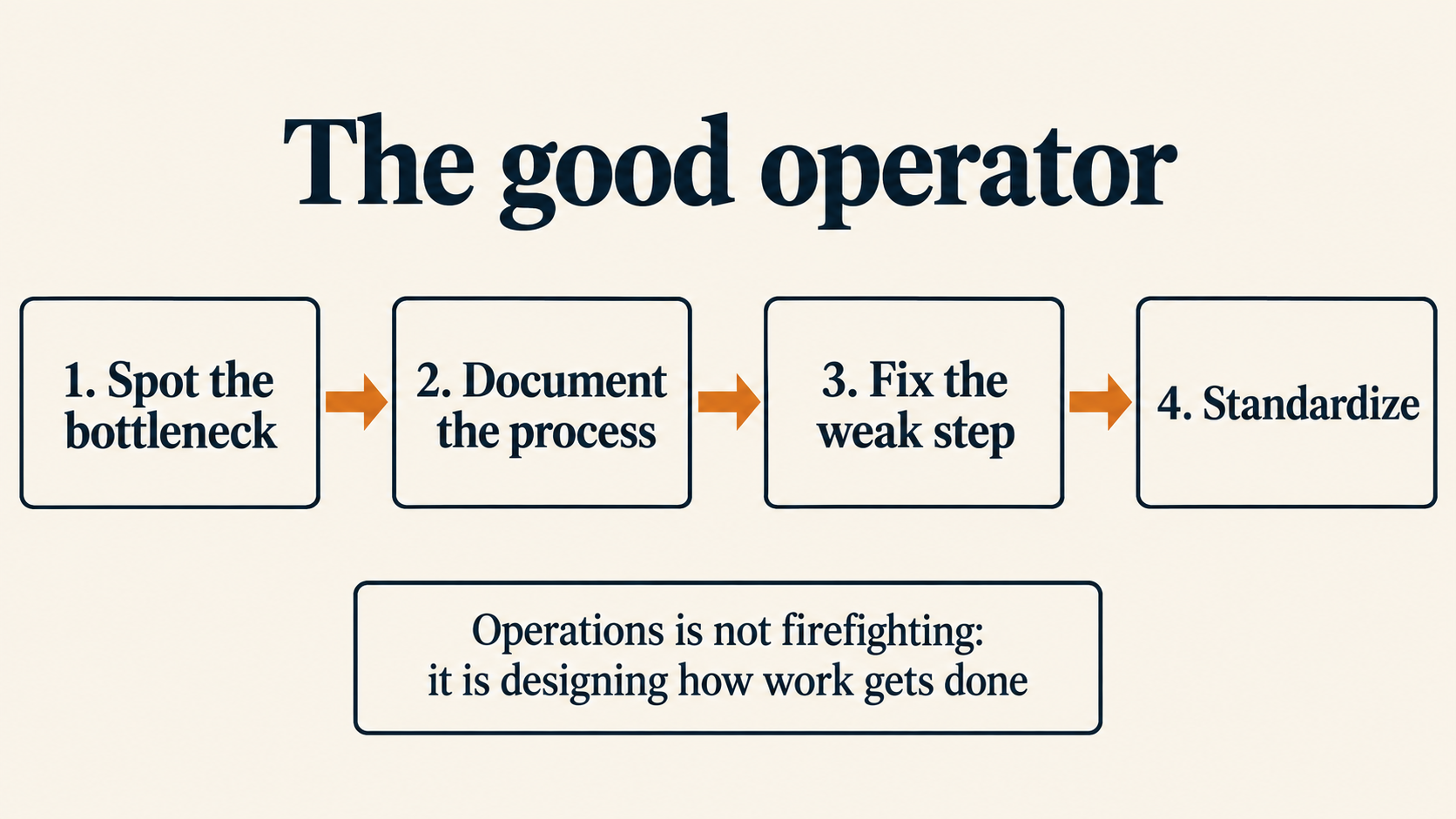
- Improves the process, not just the case: if the same error happens twice, the third time there is a checklist, a template, or an agreement preventing it.
None of this requires genius. It requires something rarer: consistency.
Why this accelerates your career
Here is the part that matters for you. Talent draws attention, but trust gets promoted. And trust is built with operational evidence: delivery after delivery, without drama and without surprises.
The person deciding a promotion runs a quiet calculation: "if I give this person more responsibility, will I sleep better or worse?" Good operators are the answer to "better". You can hand them a bigger team, a key client, an ambiguous project, and you know things will either work or you'll hear about it in time.
There is a second benefit: operational skills transfer everywhere. Industries change, tools change, companies change. The ability to make things work, consistently and without drama, is useful in all of them. It is the most portable career insurance available.
Common mistakes
- Confusing busy with operator. Running all day is not operating; it is reacting. The operator makes the machine run; they don't run after the machine.
- Keeping everything in your head. It can feel like job security ("nobody can do this without me") but it's a trap: you can't grow, can't take a real vacation, and can't get promoted, because moving you would break everything.
- Fixing the case, not the cause. Rescuing the urgent delivery for the tenth time instead of asking why it is always urgent.
- Hiding problems until they're big. Usually done with good intentions ("I'll fix it before anyone notices"), it destroys the most valuable thing you have: the trust that you give early warnings.
How to start operating better this week
Three things, all doable from Monday:
- One list, one place. Everything pending that you own goes into a single place (an app, a notebook, whatever you'll actually use). Not three chats and your memory. One. Review it at the start and end of the day.
- Give one early warning. Pick the item most at risk of slipping and flag it today, with options: "this may move to Friday; we can deliver part Thursday or everything Friday - which do you prefer?" Saying that once teaches people how you work.
- Fix one recurring annoyance. The thing that wastes time every week: the report rebuilt from scratch, the question that always arrives, the file nobody can find. Spend one hour making sure it doesn't repeat: a template, a document, an agreement. It is the best hour of your week.
The closing idea
Operations has a bad reputation because it is invisible when it works. Nobody applauds the delivery that simply arrived. But everyone remembers who makes things work.
Being a good operator is the least glamorous and most reliable career strategy there is: become the person whose yes means yes, whose Thursday means Thursday, and whose name comes up when someone asks "who can we trust with this?"
The applause for strategy is loud and brief. The trust a good operator builds is quiet and it accumulates. Only one of the two opens doors consistently.
A good system needs someone who sees how the pieces fit: why every team needs a systems thinker.
Was this article helpful?