

Claude Code: Real Projects to Learn by Building
Five projects in growing order to learn Claude Code: the skill each one practices, how long to expect, and the common traps when directing an agent.

Claude Code is learned by building, one finished project at a time. The documentation answers specific questions and the commands stick with use, but the core skill, directing an agent across a real project, only shows up when the project is yours, you care about the outcome, and every decision carries consequences.
This guide proposes five real projects in growing order of difficulty, each designed to practice one concrete Claude Code skill: directing the agent, verification with tests, git and review, external APIs and rescuing inherited code. If your environment is still being set up, the step-by-step installation and first project guide gets you ready in one session.
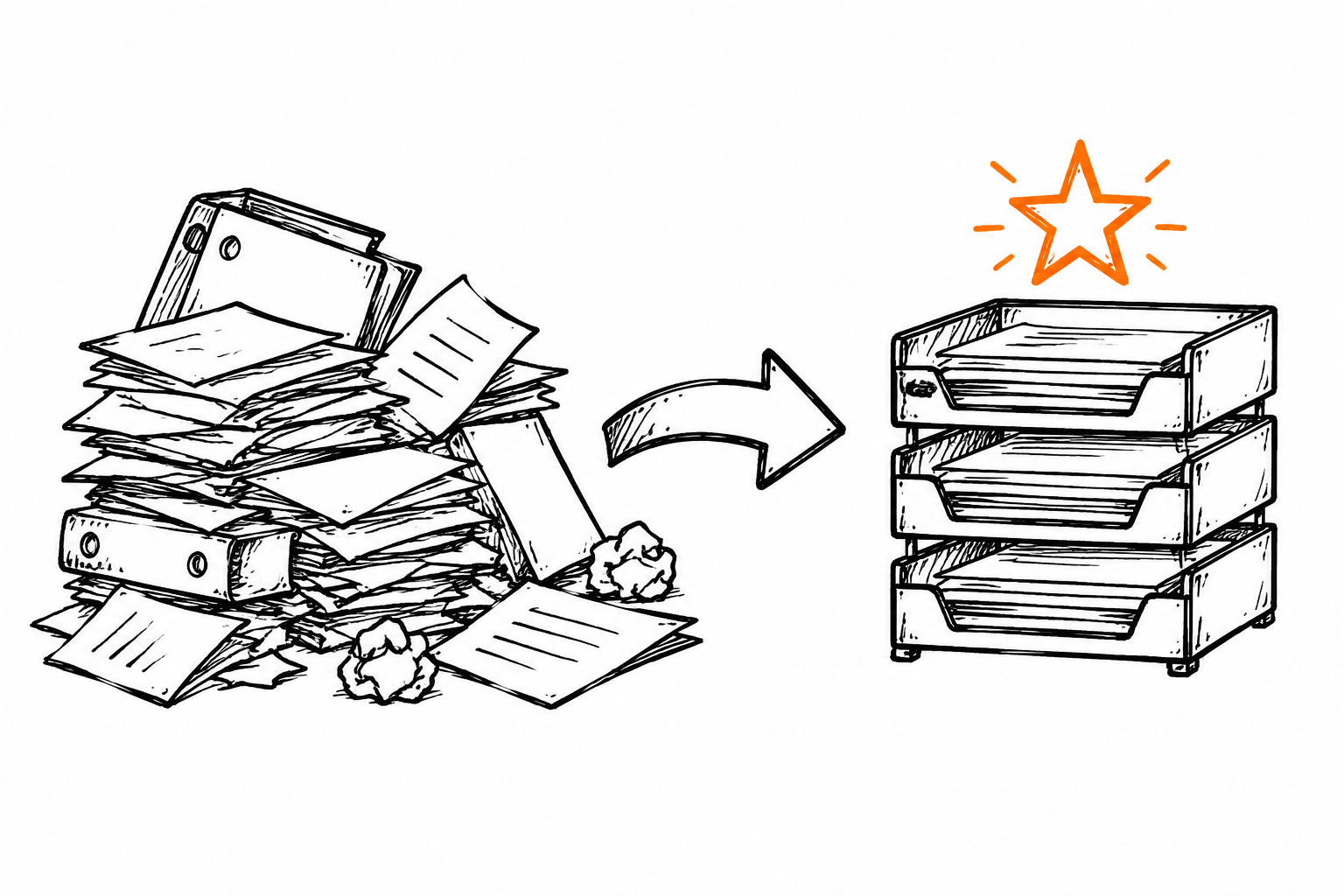
How to pick a good learning project
A learning project meets four conditions. It is personal: it solves something that happens to you, because that keeps motivation alive for weeks. It is bounded: it fits into evenings, because endless projects die before they teach. It uses real data: files, dates, expenses or texts of yours, because real work exposes cases that toy examples hide. And it has a verifiable result: you know clearly when it works, because that verification is exactly what you will ask of the agent.
With those four filters, almost any idea from your backlog qualifies. If you have several candidates, the winner is the one you would solve this very week even by hand: that real urgency is the best filter of all. The five below are ordered so each one adds a single new skill on top of the previous, and each ends with something you keep using.
Project 1: a command-line file organizer
The first project is a small tool that tames a chaotic folder: downloads, screenshots, invoices. The program classifies files by type and date, renames them with a consistent format and reports what it did. It is a classic for a reason: it finishes in one or two evenings and touches file reading, simple design decisions and an instantly visible result. One detail that makes it real: run it first in read-only mode, where it only proposes the renaming plan, and switch it on for real once the plan looks right. That simulation switch is a practice you will repeat in more serious tools later.
With Claude Code you practice the basic cycle here: describe the goal, review the plan it proposes, accept or correct, and ask for adjustments in natural language. It is also the moment to create your first CLAUDE.md with two or three project rules and watch how the agent respects them in every later session, adjusting it whenever you discover a new preference.
Project 2: a personal tracker with your own data
The second project records something from your life with real data: expenses, habits, sleep hours, workouts. It stores entries in a simple file, computes totals and trends, and shows a weekly summary. The difference from a tutorial exercise is that the data matters: when the math matches your reality, trust in the tool becomes concrete. The file format matters little at first; picking one readable by hand lets you review the data in any editor and understand every calculation the agent runs on it.
The new practice here is verification. You ask the agent to write tests for the calculations, add edge cases and run everything before each change. You learn to demand evidence instead of accepting plausible answers, the most valuable habit in agent work.
Project 3: your personal static site
The third project is public: a static site with your name, your projects and a way to reach you. Static generators come in many flavors; any of them works. Ask the agent for two options with each one's advantages for your case and choose in five minutes: the lesson lives in the published site, and every extra hour of comparison steals from that goal. What matters is that the site goes live, on your own domain if you have one, and that every change flows through git.
The new skill is working with history and branches: you request changes on a branch, review the full diff calmly, merge when you approve, and learn to revert cleanly when something reads better on paper than on screen. Claude Code handles git fluently, and learning to review its diffs is the foundation of all later code review. The set of commands and shortcuts for daily work starts turning into muscle memory during this project.
Project 4: an automation with an external API
The fourth project connects to the world: a small service that queries a public API, weather, exchange rates, listings, and sends you a summary on demand or on a schedule. Credentials, response formats, retries and timing show up here, the whole machinery of software that talks to other systems. Start by querying the API by hand once and saving the real response to a file: that concrete example becomes the reference the agent uses to design the code and tests, and it skips entire cycles of guessing.
The new practice is directing the agent with someone else's documentation: pasting the API reference, asking it to design the client, correcting its assumptions with real responses from the service. You also learn to delimit what the agent may touch: keys live outside the code and outside the agent's reach, in environment variables.

Project 5: rescuing an old project of yours
The final project is the most formative: take one of your abandoned projects, the kind that works but embarrasses you to open, and modernize it with Claude Code step by step. Update dependencies, add tests where they are missing, rename what is confusing, write the README it deserved. Working on existing code with your own context is exactly real professional work, and it teaches more than five from-scratch projects.
All the earlier skills come together here: the agent explores first and explains what it understood, you correct its map of the project, and every change arrives with tests and a reviewable diff. The most valuable moment comes when the agent finds something you remembered differently: comparing its reading of the code with your memory of the project teaches you to keep CLAUDE.md updated, which is the shared memory of all future work. The underlying goal is trust in the process: exploration, plan, bounded change, verification, clean history.
How long each project takes
With one or two hour sessions, the organizer takes one or two evenings, the tracker about three days, the personal site a full weekend, the automation another week of evenings and the rescue two or three weeks depending on the old project's size. These are estimates for someone starting out; speed rises with each project because the growing skill is yours as a director, and that transfers whole to the next one.
If a project stretches longer, the cause is almost always scope: cut one feature, ship the small version and leave the expansion for later. Finishing small projects teaches more than dragging big ones, and a finished tool in daily use keeps teaching long after the last session.
What each project practices
The full ladder looks like this: the organizer teaches the basic direction cycle and CLAUDE.md. The tracker teaches tests and demanded verification. The personal site teaches git, branches and diff review. The automation teaches APIs, secrets and external documentation. The rescue teaches inherited-code exploration and trust in the process.
Each project also leaves a useful asset: something you will use every week and can show. Close each one with a short three-line log: what you asked the agent, what you had to correct and what you will do differently next time. That double reward, learning plus tooling, sustains consistency better than any course.
Common traps when learning with an agent
The first trap is accepting everything the agent proposes out of inertia. The agent produces fast and confidently, and the temptation to approve it all grows with the speed; the defense is a personal rule of reading every full diff until trust is earned project by project. The second is asking for too much in one instruction: big requests produce big, hard-to-review changes, while bounded requests keep every step verifiable.
The third is abandoning the project at the first stumble, exactly when the learning was about to start. An unexpected behavior in the code is precisely the highest-learning moment: ask the agent to explain what happened, reproduce it with a test and fix it. That complete cycle, surprise, explanation, test, fix, is the lesson tutorials consistently miss, because it only exists when the code and the stakes are yours.
Closing
Five projects, five skills, a few weeks of evenings. At the end you hold a working portfolio, a workflow proven on your own code and the judgment to direct agents on bigger projects. Order matters less than consistency: pick the first one this week and finish it before opening the next. And keep every project in its own repository with its CLAUDE.md, because together they form the measurable record of your progress directing agents.
Sources
Was this article helpful?