
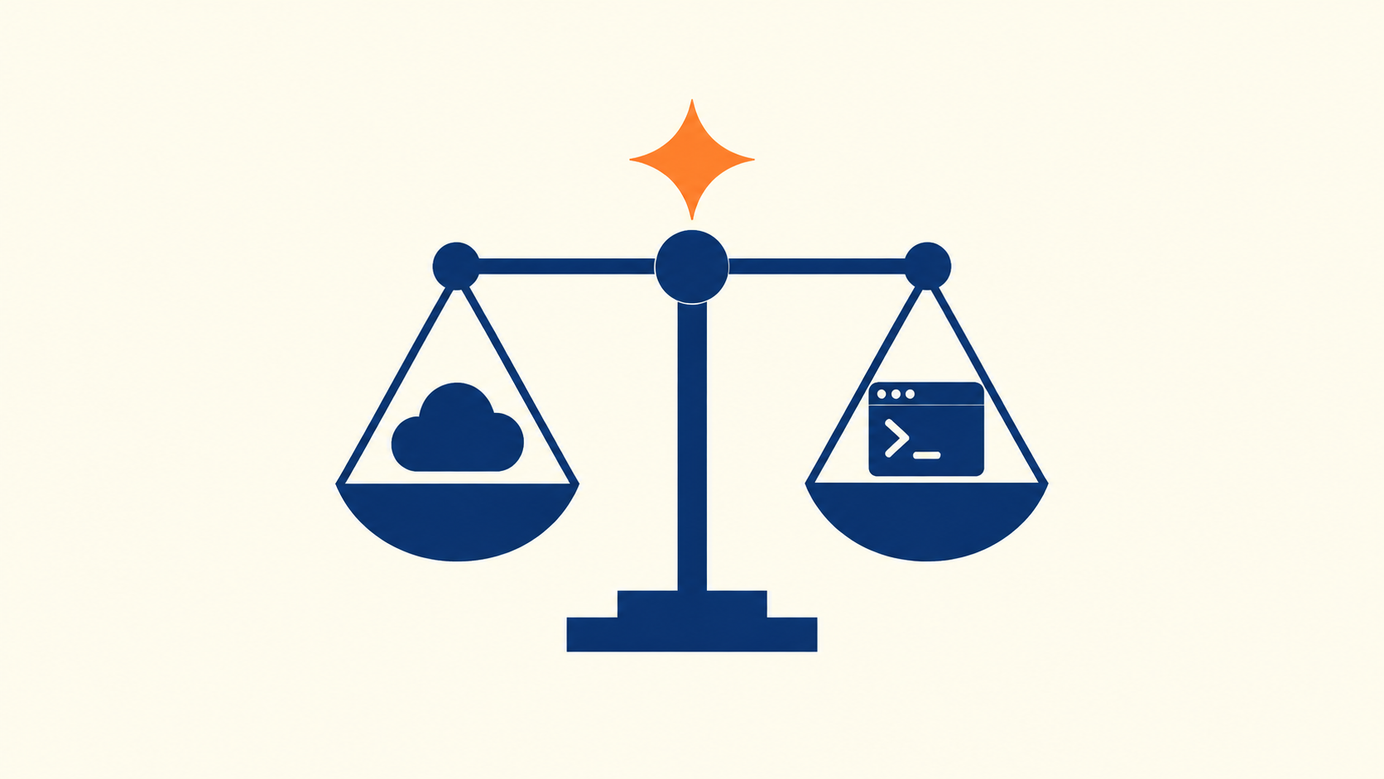
Codex vs Claude Code: When Each One Fits
Codex delegates closed tasks in the cloud; Claude Code converses in your terminal. Scenarios, a combined split, three metrics and a one-week test to choose.

Once you understand how each tool works, the practical question is different: in which situations Codex fits and in which Claude Code does. The answer depends less on model quality, today evenly matched across most tasks, and more on where the agent lives, how you hand it work, and how much control you want during execution.
This guide turns that difference into concrete decision criteria, with scenarios you will recognize from daily work. If you need the general workflow map first, with installation, environments and day-to-day mechanics, the comparison of workflow differences between Codex and Claude Code covers it in detail; here we go straight to the choice.

The core difference in one sentence
Codex lives mainly in OpenAI's cloud: you assign it tasks, each one runs in an isolated environment with your repository, and you receive the result as changes ready for review, usually as a pull request. Claude Code lives on your machine and in your terminal: it works on the repository you have open, with direct access to your files, your tests and your commands, in a continuous conversation where you see every step.
Almost everything else follows from that difference, including the rhythm each tool imposes on your day, the kind of review work each one generates, and the moment of the week when each one earns its place. A cloud agent performs best when work can be delegated and reviewed later. A local agent performs best when the work needs dialogue, deep context and mid-course decisions.
When Codex fits
Codex shines when the task can be written out completely before it starts. A bounded adjustment with a clear acceptance criterion, a mechanical migration repeated across many files, a round of tests that needs expanding, documentation missing from a module: all of that can be described in a paragraph, delegated, and reviewed when you get back. Codex's unit of work is the closed task, and its strength is processing several in parallel while you do something else.
It also fits when the work lives inside GitHub's review dynamic. Results arrive as pull requests with isolated changes, so they slot naturally into teams that already run on reviews: the agent produces, people review, and the history stays clean and attributable.
And it fits maintenance seasons, when the goal is keeping many small things healthy at once rather than pushing one big thing forward. It fits fragmented time too. You can queue three tasks before a meeting and review the results when you walk out. It also works as a second production line: while you push the main task forward, a queue of secondary adjustments resolves in parallel, and one shared review at the end of the day turns idle hours into measurable progress. That asynchronous delegation pattern is exactly what a cloud tool exploits best, because the agent keeps working while your laptop is closed.
When Claude Code fits
Claude Code shines when the task is discovered by working on it. Exploring inherited code to understand why it behaves a certain way, designing a new feature where half the decisions appear mid-way, debugging something that only reproduces in your environment: in those cases the continuous conversation with the local agent is the tool itself, because each answer feeds the next question.
It also fits when context is large and local. The agent reads your entire repository with your own commands, runs your tests on the spot and adjusts as it goes. For refactors that touch many files with judgment, that closeness to the real project translates into proposals that respect the conventions of the existing code.
It also fits deep focus sessions, where interruptions to wait for a remote queue would break the state you are holding in your head. And it fits learning. Watching the agent reason step by step, accepting or correcting each change and asking why it chose a path is a form of pair programming that teaches while it produces. Anyone migrating to a new language or framework finds a considerable shortcut in that conversation: the agent knows the new ecosystem's conventions and applies them to your code, explaining them when asked. If the goal includes understanding the result, the interactive session is worth as much as the code.
By the way you work
The choice also depends on your context. If you work on a team with mandatory reviews and a shared board, Codex integrates into that existing choreography: each delegated task returns as a pull request entering the usual process, with its discussion and its history. Adoption barely changes the team's habits.
If you work mostly alone or on your own projects, Claude Code usually absorbs more value: the interactive session replaces the partner who reviews with you, and the conversation remains as a record of why each decision was made. In long personal projects, that reasoned record of the work becomes living documentation.
There is also a difference in what each one asks of you. Codex requires describing the task in writing with precision, a skill that improves with practice and improves your own tickets along the way. Claude Code requires availability to converse, read proposals and correct in time. It is worth asking which of those two investments fits your actual week better.

Concrete scenarios
Backlog cleanup: ten small, well-described adjustments, each with its acceptance criterion. Codex fits: they queue up, run in parallel and return as pull requests ready to review in a single sitting.
Investigating strange production behavior, with local logs and a large repository. Claude Code fits: exploration is iterative, every clue redefines the next search, and the environment where the phenomenon happens is your machine.
Preparing a library migration with mechanical changes across dozens of files. Codex fits the mechanical pass, given a precise description with before-and-after examples; human review concentrates on the special cases.
Design and implementation of a new feature with open architectural decisions. Claude Code fits: the design matures in conversation, and the agent proposes alternatives against real code while you set direction.
Pending documentation across several modules. Codex fits: each module is a closed task, delegable and reviewable on its own.
Demo preparation with last-minute changes and quick decisions. Claude Code fits: local conversation latency is measured in seconds and every adjustment gets tested on the spot in your environment.
When to use both at once
The most productive division I have seen in practice assigns each tool the kind of work it processes best: Codex handles the queue of bounded tasks that always exists in a living project, while Claude Code accompanies the deep work that requires judgment and dialogue. The mental cost of keeping two tools pays for itself once each absorbs what the other would handle with more friction.
The key lies in the discipline of description. Tasks delegated to the cloud need complete statements and acceptance criteria; local sessions need your attention and judgment available. Mixing up those two modes, delegating the ambiguous or micromanaging the bounded, is the main source of bad experiences with either tool. The practical rule that summarizes the division: if the task fits in a well-written ticket, send it to the cloud; if the task fits in a conversation, send it to the terminal. When doubt persists, start with the conversation, because what you learn in it will tell you whether the work can later become delegable tasks.
What to measure after choosing
The choice gets reviewed with three simple metrics. First, cycle time: how long a typical task takes from the moment you describe it until the change is integrated, including your reviews. Second, rework rate: how many correction rounds each result needs before it is ready. Third, your own attention: how many minutes of real focus each delegated task consumes compared to doing it by hand.
With those three figures from a few weeks, the comparison stops being theoretical and the right tool reveals itself in the numbers. If you also share the measurement with your team, the decision becomes a working standard instead of a personal preference, and new joiners learn the criterion from day one.
How to decide with your own work in one week
The best test uses your real work. Pick a typical week and sort every programming task into two columns: delegable with a complete description, or exploratory with dialogue. If the first column dominates, Codex absorbs more value; if the second does, Claude Code is the natural base. Most people find a mix, and that proportion measured with your own tasks is worth more than any generic comparison, including this one.
Also record where you felt friction: waits, repeated review rounds, context the agent ignored. That log, crossed with each plan's current limits, turns the choice into a decision backed by your own evidence, ready to be revisited each quarter as both tools evolve. For the budget side, the guide to free options that deliver shows how far you can get before paying, and the official pages linked below carry each plan's current limits.
Sources
Was this article helpful?