

Strategic or tactical? The difference that changes how you work (and how you're seen)
There is a phrase that quietly shapes more careers than any performance review: "we need you to be more strategic." It usually arrives in a meeting, with good intentions and without much explanation of what it actually means.


There is a phrase that quietly shapes more careers than any performance review: "we need you to be more strategic." It usually arrives in a meeting, with good intentions and without much explanation of what it actually means. So the person nods, works harder, and six months later hears the same sentence again.
The problem is rarely effort. It is that the difference between tactical and strategic work is seldom explained. Let's fix that here.
The quick definition
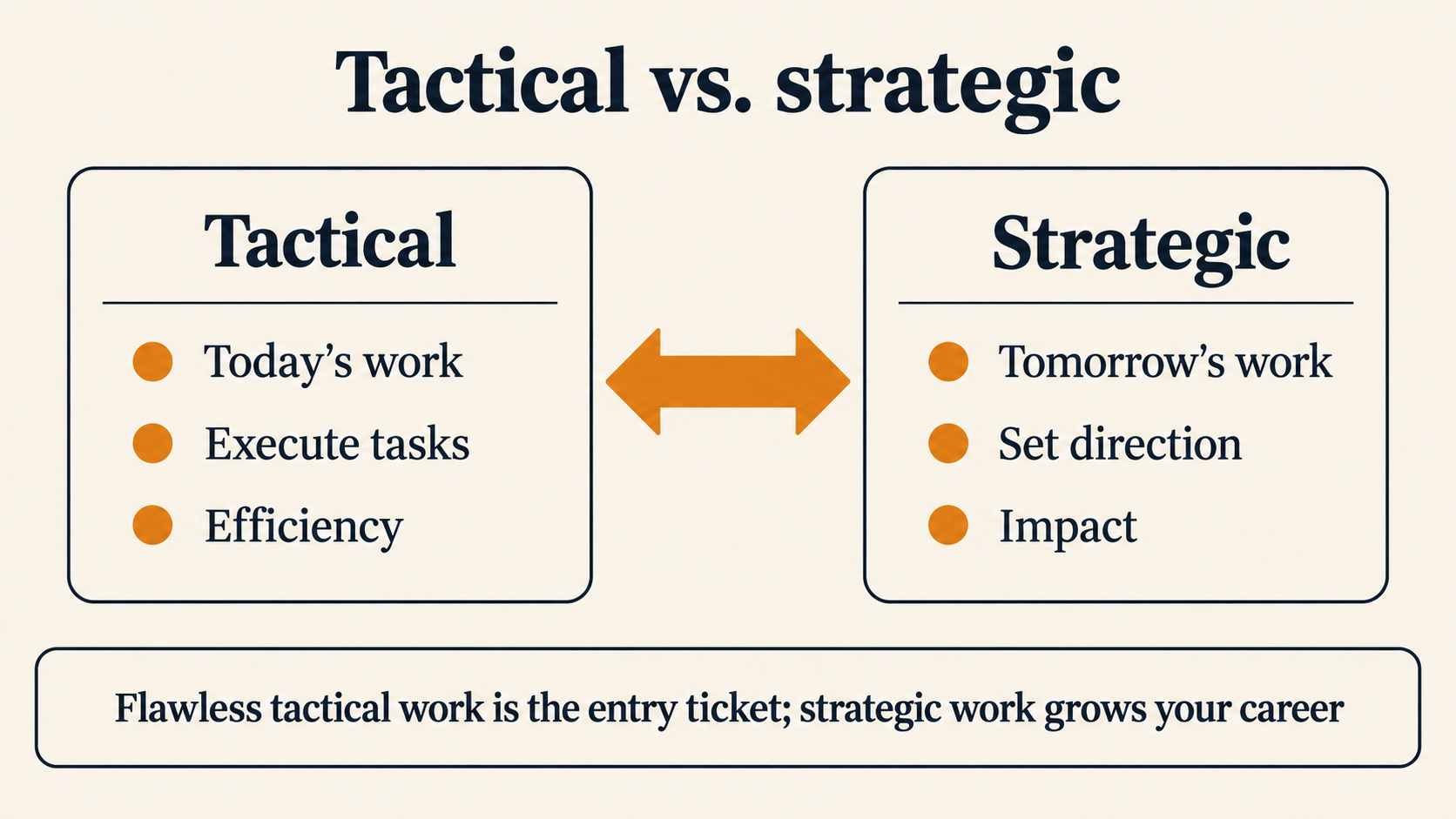
Tactical work is everything that answers: what has to get done today? Attend to requests, deliver reports, resolve tickets, put out fires. It is concrete, measurable, and urgent.
Strategic work is everything that answers: what should exist so tomorrow looks different? Designing processes, deciding what will no longer be done, building skills, choosing where to place effort before problems arrive. It is less tangible, and almost never urgent.
Here lies the trap: the urgent consistently wins over the important. Nobody stops you in the hallway to say "you haven't thought strategically this week", but they do stop you to say "that report is due today". So the tactical consumes the entire day, every day, and the strategic waits for a free Friday afternoon that never comes.
If you want to build a full strategy step by step, here is the guide: what a strategy is, how to build one and how to execute it.
The classic signs you're operating only in tactical mode
- Your week is a list of fires you put out. You arrive with a plan and leave having done nothing on it.
- When you say "I have no time", what you usually mean is "other people's priorities filled my calendar".
- Your achievements are hard to explain beyond "I did my job well".
- Every project stalls when you get sick or take vacation. You're not working on a system; you are the system.
If three of those sound familiar, you are in good company: that describes most professionals, most of the time.
What being strategic actually looks like
Being strategic is not a personality trait or a job title. It is a set of observable behaviors:
- Asking "why" before "how". The tactical reflex says "how do I produce this report faster"; the strategic one asks whether the report should exist, who reads it, and what decision it feeds.
- Connecting dots. They know what their team does AND how it affects sales, finance, the customer. That context lets them see problems before they surface.
- Saying no with an argument. Not a capricious no: "if we do this, we stop doing that, and that matters more because...". That sentence, used well, is worth more than ten delivered reports.
- Investing time that doesn't pay off today. Documenting, automating, teaching. All of these cost hours this week and return months later.
- Thinking in systems, not events. If the same problem appears every month, the tactical response solves this month's case; the strategic one changes whatever generates the case.
The trap of going too far
There is also the opposite failure: the person who "only thinks strategically" and delivers nothing. Pure strategy with no execution is speculation; pure execution with no strategy is motion without direction.
One heuristic people find useful here - a rough rule of thumb, not a universal law - is something like 80/20: most of your time executing well (because your credibility comes from delivering), and a protected block, even two hours a week, for strategic work. The exact split depends on your role and your week; the key is that the strategic part is protected: on the calendar, with a name, like a meeting with your most important client. Because, in a real sense, it is: that client is your career in three years.
Systems thinking is part of that strategic layer: why every team needs a systems thinker.
How your boss reads it
This is the part that rarely gets said out loud. When someone gets promoted, the deciding person usually asks themselves one question: "can I trust this person with things I won't have time to watch?"
The fully tactical profile inspires confidence for continuing exactly what they do today. That is why so many excellent executors stay in place: they become too valuable in the role nobody wants to move them out of. The strategic profile, even with a small protected block, signals that you see beyond your desk, that you understand the game, that you can be trusted with the next level of ambiguity.
Being more strategic doesn't mean doing less of your job. It means your job starts leaving traces that outlive the day: processes, decisions, clarity for others.
An exercise for this week
Open last week's calendar and sort each block into one of two columns: fire (someone else's urgency, a reaction) or construction (something that will still be useful in six months). Don't judge the result; just count it.
Then choose one recurring fire, the most annoying one, and write down: "what would make this fire never start again?" Automate it, document it, delegate it, or eliminate it. That answer is your first strategic move of the week. Two hours. Protected.
And the next time someone asks you to be "more strategic", you will have something better than a nod: a Tuesday afternoon with a plan.
Was this article helpful?