
Your company is very busy with AI. Busy, or moving forward?
There's a scene that repeats in a lot of companies: someone proudly reports in the meeting that everyone has AI licenses now, 80% finished the course, and three pilots are underway. Everyone nods. It feels like progress. Then you look at the actual work and...


There's a scene that repeats in a lot of companies: someone proudly reports in the meeting that everyone has AI licenses now, 80% finished the course, and three pilots are underway. Everyone nods. It feels like progress. Then you look at the actual work and... it's exactly the same. Same processes, same timelines, same results, now with more apps open.
I call this confusing activity with impact, and it's the first big trap described in the Harvard Business Review article this series is based on. The authors say it plainly: leaders celebrate pilots, licenses, and completed training because they're easy to count. The problem is those metrics can create a false sense of progress: people look busy with AI while the work, the operating model, and the sources of value stay largely unchanged.
The real test
The article proposes an uncomfortable test: the measure of adaptation isn't whether people use AI, it's whether AI is changing how work gets done. How fast people decide. How often they experiment. How often a possibility turns into a better outcome.
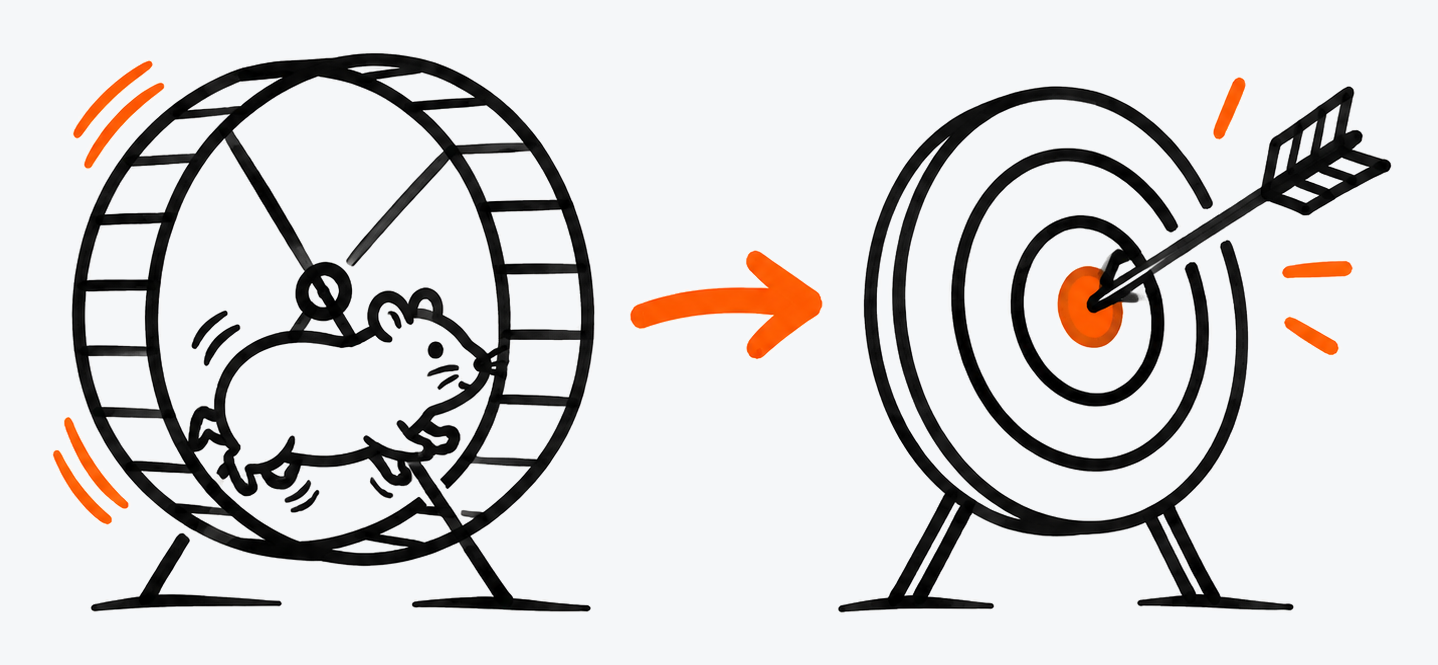
Think about it with something from your business. If your team "uses AI" to write the same emails as always, only prettier, you have activity. If it uses AI to answer quotes in an hour instead of three days, and that wins you clients who used to go cold, you have impact. The tool is the same; the difference is what you measured.
The case that illustrates it
The article tells the story of a pharmaceutical company, a Korn Ferry client. AI adoption was tracked through usage, so usage became the implied definition of success: people used the tool so it would show they used the tool. The fix was to move the change into the talent system: more than 500 senior executives were assessed against an AI-era leadership profile, leadership roles were redefined to include explicit AI accountabilities, and AI outcome indicators went into performance reviews and promotion criteria. The message changed from "use AI" to "create value differently with AI."
You don't need 500 executives to steal the idea. The lesson fits in one line from the article: measure work by the value it creates, not the activity it generates, and use those measures to keep learning and adjusting.
Why we fall for it (and it's not because we're dumb)
Activity has three unfair advantages over impact: it's easy to count, it's visible fast, and it doesn't pick a fight with anyone. Saying "we bought 50 licenses" bothers nobody. Saying "this report that's existed for years is no longer needed by anyone" does, because it touches somebody's job. That's why what the article calls process-centric organizations ask "did we follow the steps?" while outcome-centric ones ask "did we get what we wanted?".
And there's a nice consequence: when the focus is the result, the method stops being sacred. If another way delivers a better result, you change the method and move on. Adaptation stops being a threat to good work and becomes part of good work. When the focus is the process, any new tool is a threat to the process, and that's where the resistance begins that nobody can explain later.
What it looks like in a small business
No transformation department, no consulting budget. The trap looks like this:

- "We already pay for AI" as an achievement in itself.
- "So-and-so uses it a lot" as a measure of progress.
- "We have a WhatsApp group where we share prompts" as a strategy.
None of that is wrong as a step. It's wrong as the goal. The impact version sounds like: we answer quotes 60% faster; the weekly report builds itself and only gets reviewed; the freed-up time went into visiting clients. Notice all of that can be measured in a 10-person business without buying anything new.
One important clarification
Measuring impact doesn't mean measuring everything or turning every task into a number. It means being clear, among the few indicators you actually track, which ones measure results and which ones measure motion. Active licenses and completed courses aren't garbage: they're signals that people have access and context. The mistake is treating them as the finish line when they're, at best, the exit of the tunnel.
Watch out for speed mirages
A modern trap: AI does produce fast results, but activity results. The email is done in seconds, the report generates itself, the deck is ready in an afternoon. All of that is saved time, and saved time isn't impact until somebody decides what to do with it. If the recovered hours evaporate into more meetings and more scrolling, you bought efficiency to stay the same. The closing question isn't "how much time did we save?" but "where did that time go?".
What to do this week
- List what your business brags about on AI. Translate each point into a result: what changed for the client, the cost, or the time? Whatever has no translation is activity.
- Pick ONE impact metric per area (response time, errors, hours recovered, closed sales). Just one. Measurable without new software.
- Ask in your next meeting: "what would stop existing if we actually believed this tool?". The silence that follows is information.
Questions to ask yourself
If every AI license disappeared tomorrow, which business results would get worse? If the answer is "none," you were measuring activity.

What work exists only because "it's always been done"?
Who did I last recognize: the one who followed the process or the one who got the result?
One last nudge
If you only take one thing from this post, take the habit of translation: every time someone (including you) reports progress on AI, translate it on the spot into client, cost, or time. It feels pedantic the first three times. Then it becomes the way your company talks, and at that point the activity metrics start looking as empty to everyone else as they are.
The takeaway
AI generates activity almost for free: courses, pilots, groups, enthusiasm. Impact costs more: it requires deciding what result you want and accepting that the method may change. The good news is the difference between the two is almost never budget; it's the question you choose to ask.
Source: "There's No Such Thing as an AI-Ready Culture", Sarah Jensen Clayton, Michael Welch and Khoi Tu (Korn Ferry), Harvard Business Review, October 5, 2026. https://hbr.org/2026/10/theres-no-such-thing-as-an-ai-ready-culture
Was this article helpful?