

AI agents for business: what they are and where to start
AI agents for business: types, processes, permissions and an implementation proposal with verifiable results.


AI agents for business turn a conversation into a sequence of tasks, tool calls and checks. In a 2025 survey, 88% of respondents reported regular AI use in at least one organizational function. That figure describes survey responses about AI in general; agent adoption requires its own measurement. Using a writing assistant and allowing software to change an order are different activities. This article organizes the landscape: what an agent is, which types exist, how to evaluate results and how to prepare an implementation with verifiable limits.
What are AI agents for business?
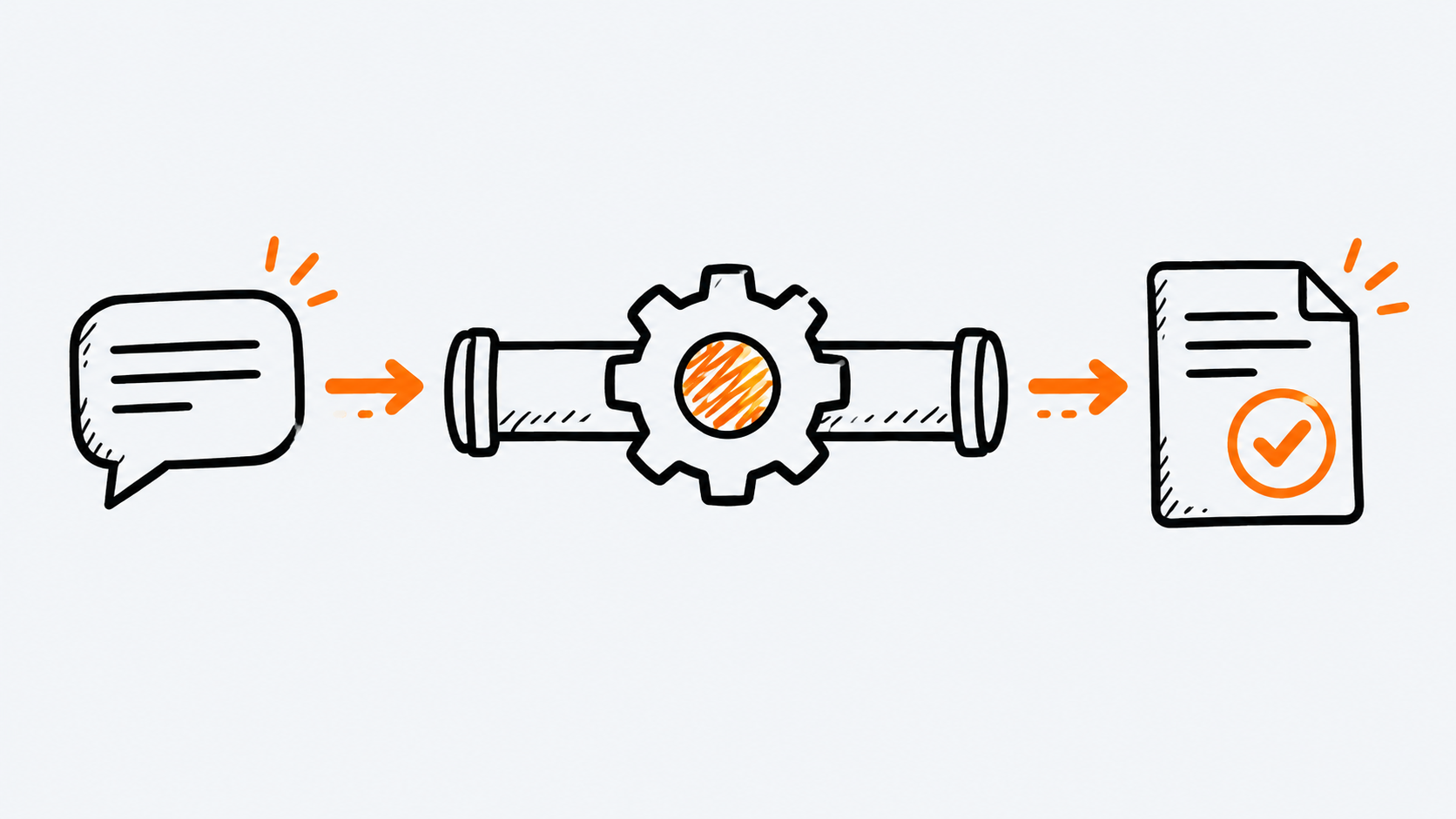
An AI agent combines interpretation and execution. It receives an objective, such as preparing a billing close, answering recurring requests or updating a CRM from authorized calls. It then organizes steps, consults tools and delivers a verifiable result. A chatbot centers on conversation; an agent incorporates actions into a process. The actual autonomy depends on configured permissions and the review established for each type of work and its intended outcome.
Three components set it apart from any other software with AI inside:
- Language model. Interprets instructions and proposes the next step from available context. Its outputs require the checks defined for the assignment.
- Connected tools. Supply authorized access to email, spreadsheets, ERP, CRM or other services. Each integration has a specific scope.
- Execution cycle. The system observes each action result, updates context and continues or requests review according to the procedure.
A forecast published in June 2025 estimates that by 2028, 33% of enterprise software applications will include agentic AI, compared with a share below 1% in 2024. This is a market forecast. A particular project should be selected using its own data, permissions and tests. That distinction helps treat trends as context while using process evidence as the basis for an implementation decision.
Types of AI agents
Agents can be organized along two useful dimensions: level of autonomy and business function. A single application can combine several capabilities, so it helps to describe which actions it will perform at each stage and who reviews the result. This classification supports implementation design and provides concrete questions for evaluating a proposed solution against a defined process.
By level of autonomy
- Response assistants. Answer questions using company information within a bounded action scope.
- Copilots. Prepare drafts, summaries, code or analysis for human review and approval.
- Agents with configured autonomy. Receive a trigger, perform authorized actions and report. Permissions and controls define their scope.
By business function
- Sales: prospecting, lead qualification, CRM updates, follow-ups.
- Support: resolving repetitive tickets, classification and routing, knowledge-base answers.
- Operations: reconciliations, data entry, report generation, coordination between systems.
- Finance and administration: invoice processing, transaction review, assisted period closes.
- Software and data: coding agents, testing, documentation and analysis. The open source repository library collects dozens of these verified tools.
One implementation option is to start with a copilot on a bounded task and review its outputs before increasing autonomy. Each process needs its own evaluation of expected benefit, total cost and achieved quality. Progress is decided using that evidence and the actual conditions of the environment, including the responsibilities of the people reviewing the work.
How reliable are AI agents for business decisions?
Reliability depends on the task, data, permissions and testing. An agent can help process tickets, invoices or CRM updates. Its capacity, accuracy and compliance should be measured on representative cases before increasing volume. Model-generated results require comparison with authorized records. Review should check facts, context interpretation and the destination of each action, including the cases that should be transferred to a person for a decision.
A useful design principle is to match autonomy to the reversibility and effect of each action. Reclassifying a ticket may support later review; a significant refund merits prior approval. A permission matrix can identify each action, its owner and its review point. The process can then combine execution speed with explicit decisions about money, data and business commitments, using criteria that remain visible during operation.
What platforms support AI agents for business?
The market is organized in four layers, and it pays to know which one you are buying:
- Models and APIs. Support building a solution with explicit decisions about integration, validation and maintenance.
- Integrated systems. Combine AI capabilities with existing productivity or management tools. Verify capabilities and access with each provider.
- Automation platforms. Connect steps across services. Selection depends on the integrations and actions required for the process.
- Open components. Support organizing parts of a solution under license and maintenance conditions that should be reviewed for each project.
Choosing among layers depends on required control, preparation time and maintenance capacity. An integrated system may fit existing tools; a custom solution offers different design choices. Evaluation should include data portability, documentation and the process for changing components. Reviewing those conditions before committing helps keep the implementation aligned with the intended workflow and the resources available to maintain it.
Where to start: a realistic implementation plan
An organized implementation begins with the process and continues with a tool suited to that scope. The following schedule is a proposed way to organize decisions and evidence:
- Weeks 1-2: select a process. Define inputs, rules, actions and a verifiable result. Choose a scope that supports complete review.
- Weeks 3-4: measure the baseline. Record time, cost and quality in the current workflow. Use that reference to compare the proposed system.
- Weeks 5-8: bounded pilot. Use representative cases and human output review. Define acceptance thresholds in advance.
- Weeks 9-12: decide with evidence. Compare results and total cost. Choose continuation, adjustment or closure using the agreed criteria.
- Months 4-6: expand with control. Extend to related processes after the first meets its defined conditions and has assigned owners.

Good practices for adopting AI agents
- Prepare the process. Document steps, inputs and decisions before automation.
- Assign responsibility. Identify who reviews results and approves each action category.
- Test representative cases. Compare demonstrations with evidence from the intended environment.
- Agree on portability. Define how data, instructions and records are preserved and transferred.
- Explain the workflow. Share the system purpose and review points with the people involved.
How much does it cost to start?
Cost should be separated into licenses, model usage, integrations, testing, supervision and maintenance. An internal automation and a system that changes important records have different scopes. Request a quote with volume assumptions, usage caps and portability conditions. A historical comparison documented a more than 280-fold reduction in inference cost for GPT-3.5-level performance between November 2022 and October 2024. That finding concerns inference under the stated comparison; a full project budget requires separate evaluation of integration, security and human review. Each category should remain visible in the estimate.
What does an agent look like at work, in practice?
A hypothetical example can help design a test. A request arrives asking for an order status. The agent identifies the number, consults the logistics record and prepares a response using the available estimated date. It can then update the history and refer the case to the responsible person according to the agreed policy. The flow requires previously configured integrations, permissions and activity records. Its feasibility should be checked with representative cases in the implementation environment.
The design preserves shipping policy, authorized amounts and commitments the business can fulfill. Permissions and thresholds are defined before work begins. An agent-prepared response can move to human review when it affects specific commitments. Documenting these conditions makes it easier to check that each action fits the assignment and that the result preserves the agreed service standard across the workflow.
Transfer to a person deserves its own design. The agent should provide the request, consulted records and the point requiring a decision. Cases needing legal interpretation, additional information or a specific authorization can follow that path. A handover with context supports continued work and preserves a record of who decided each action. The handover itself can be tested as part of acceptance.
Benefit should be measured through the outcome of the work. Available hours can support customer follow-up, task completion or delivery preparation. Record what changed, at what quality and at what cost. That relationship makes it possible to compare investment with verifiable results and decide whether to expand the process, adjust its scope or focus it on another task. The decision follows observed evidence.
AI agents for business can support concrete work through defined tasks, appropriate data and reviewable controls. Starting with a bounded scope creates a local reference. Measuring results and preserving design decisions helps extend the capabilities that demonstrate value. Implementation becomes a sequence of verifiable deliveries with clear responsibilities at each stage and a documented basis for the next decision.
How should an acceptance test be defined?
Begin with cases representing actual work and use only the data needed for the exercise. Include complete requests, inputs that require clarification and cases that should transfer to a person. Each case needs an expected result defined before running the agent. That reference supports comparing outputs with established criteria and distinguishing writing clarity, data accuracy and permission compliance during review.
An evaluation matrix can separate data accuracy, permission compliance, response quality and the ability to transfer decisions. Examine results by action class. Moving money, sharing information and updating records deserve specific thresholds and reviews. Also test how the previous state can be restored when appropriate. Evidence by category makes the acceptance decision explainable at the level of detail each effect requires, while keeping the review useful for future changes.
The twelve-week plan is a proposal whose timing depends on integrations, data organization and the required legal review. Close each stage with evidence: a permission inventory, a test set, a results log and a continuation decision. Measuring progress through demonstrated capabilities allows the pace to follow actual project conditions. The calendar is a preparation guide and should be updated when its assumptions change.
The best AI agents for business should be compared on the same task, data and constraints. A demonstration can inform a shortlist; a representative trial supplies evidence for selection. Record the model version and configuration used in each exercise so later changes can be checked against the same baseline. This creates a comparison that belongs to the process and can be maintained as tools evolve.
Sources
- McKinsey & Company, The State of AI 2025: mckinsey.com/capabilities/quantumblack/our-insights/the-state-of-ai-2025
- Gartner: agentic AI forecasts, June 2025
- Stanford HAI, AI Index Report 2025: hai.stanford.edu/ai-index/2025-ai-index-report
Was this article helpful?